From a $29 million ICO to an assumed dead product to an alleged investor fraud dispute.
A chronological history of GridPlus, its original promises, the GRID token, its departure from electricity retail, its leadership transition, and to now — termination of GridPlus's developer, a year stale Lattice firmware, and the PLH shareholder dispute.
The ConsenSys origins and the electricity revolution
GridPlus was founded in 2017 by Mark D'Agostino, Alex Miller, and Karl Kreder, emerging from the ConsenSys ecosystem.
The company's original proposition was not cryptocurrency hardware wallets. It was an attempt to revolutionize how consumers purchased electricity.
Through Ethereum, automated payments, and purpose-built hardware, GridPlus proposed giving consumers access to electricity at wholesale prices while reducing traditional energy-retailer overhead.
Its longer-term vision involved distributed energy systems, including home batteries, solar generation, and peer-to-peer electricity markets.
In July 2017, the company published a whitepaper outlining this vision.
The original promise: Blockchain technology would transform retail electricity, beginning in Texas.
The GRID token offering raises millions
GridPlus attracted substantial financial backing before its electricity platform had reached the scale that was depicted in its marketing.
The company reported approximately $29 million from its presale, selling about 36.4 million GRID tokens. A historical research profile places total token-sale proceeds at approximately $32.2 million after the subsequent public offering.
GRID tokens were marketed around an electricity-related utility: each token would provide the right to purchase 500 kilowatt-hours of electricity at wholesale prices through the GridPlus network.
The announced public ICO price was $1.15 per GRID token, although discounted presale participants paid less.
The accountability question: What ultimately happened to the utility and economic value originally presented to purchasers of the GRID token?
The shift from electricity to cryptocurrency hardware wallets
By December 2020, GridPlus had launched the Lattice1, a hardware wallet for cryptocurrency users.
Then, in March 2021, GridPlus announced that it had divested its Texas retail-energy subsidiary and would dedicate its resources to blockchain hardware security and privacy.
The company attributed its decision to systemic problems in Texas's deregulated electricity market, compounded by Winter Storm Uri and the resulting uncertainty around electricity-market settlement obligations.
This represented a fundamental shift in the business.
The company that had raised funds promoting blockchain-powered electricity access was now concentrating on securing cryptocurrency assets.
The unresolved investor question: What became of the original electricity-related token utility after the company's exit from that business?
GridPlus Texas appears in ERCOT's default and short-payment records
One of the most significant events in GridPlus's operating history arose from the Texas electricity crisis.
Following Winter Storm Uri, the Electric Reliability Council of Texas (ERCOT) published records identifying electricity-market participants with unpaid settlement balances.
Among the entities identified was GridPlus Texas Inc., the electricity-business entity associated with GridPlus.
Historical short-payment/default-uplift figures from ERCOT records. These are not verified present-day balances.
GridPlus Texas disputed ERCOT's initial characterization. In March 2021, company representatives publicly stated that they had met their stated financial obligations and that their inclusion on ERCOT's default list was erroneous.
Nevertheless, later ERCOT records continued identifying GridPlus Texas in settlement-related short-payment calculations.
The unanswered question: How were these obligations ultimately resolved, and what responsibility, if any, remains with the relevant legal entities?
GridPlus caught contradicting its own private-key security claims
On May 16, GridPlus publicly assured users that extracting private keys through firmware was impossible:
“It’s not possible to do this with the way the device is designed.”
Just two days later, GridPlus acknowledged:
“Hypothetically we could introduce new firmware that would allow private key export. But we just won’t.”
Security researcher Mudit Gupta publicly challenged the contradiction, pointing out that GridPlus had initially denied something it subsequently admitted was technically possible.
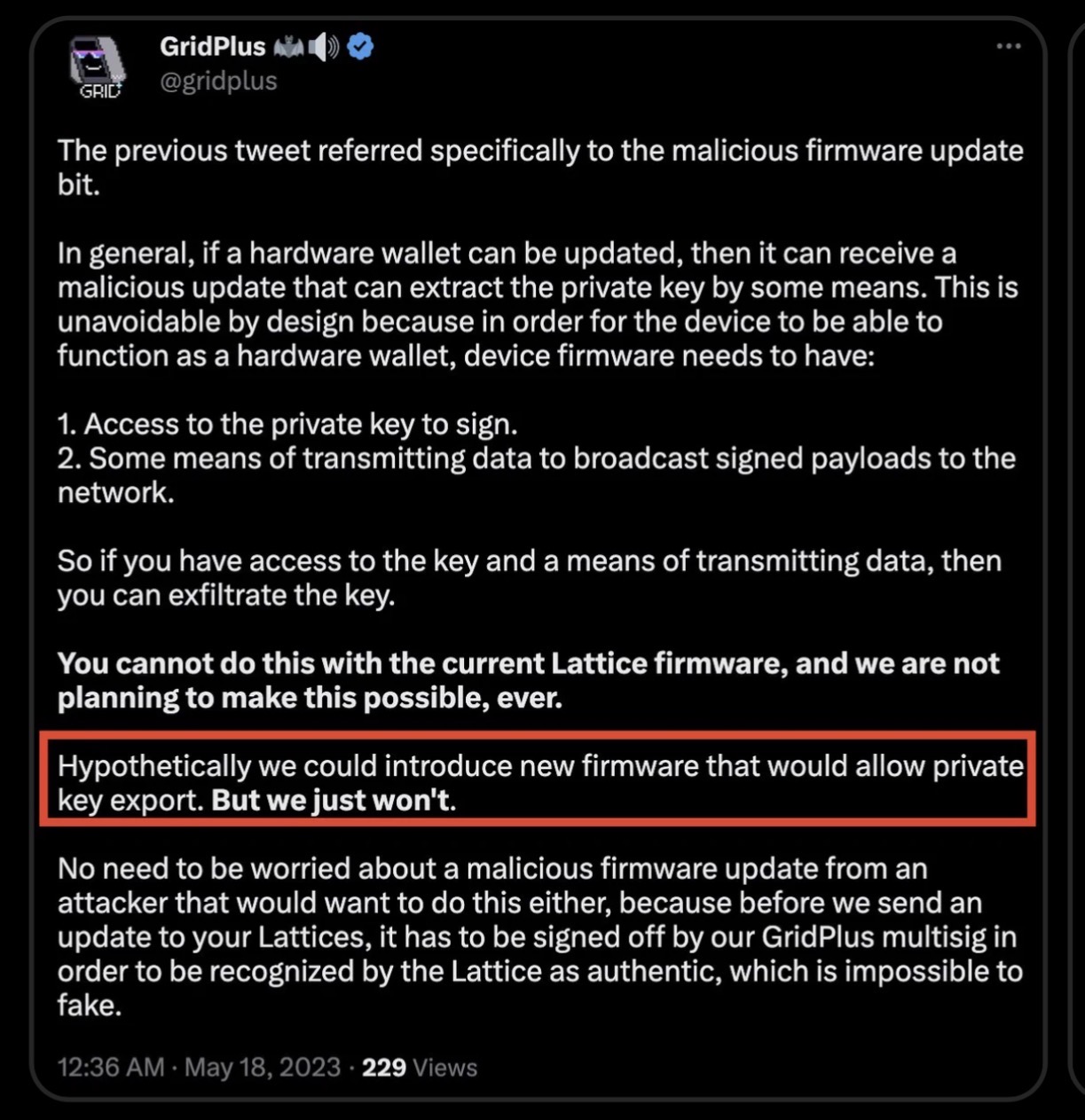
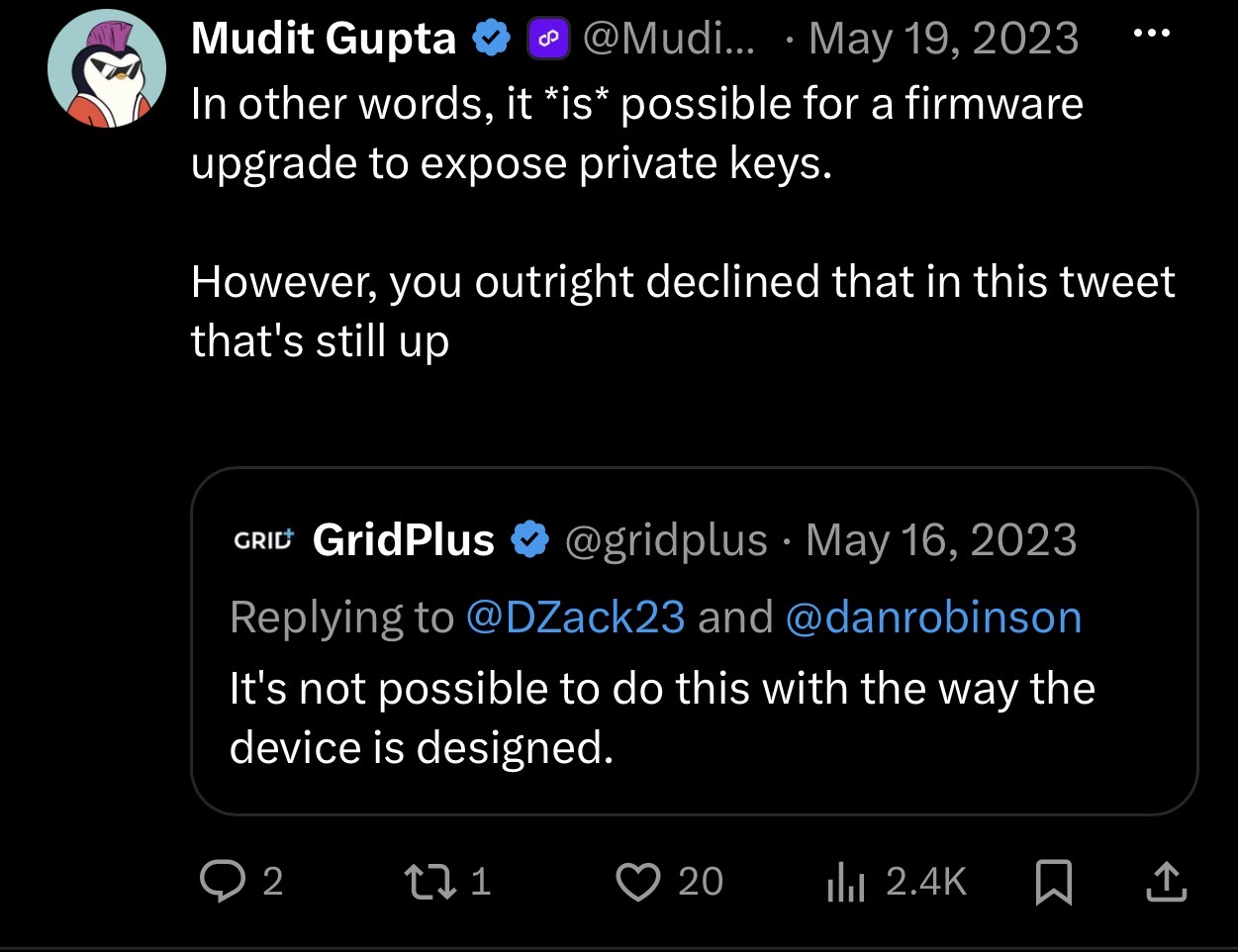
Captures of the public posts supplied by this website's maintainer; the posts were not independently retrieved from the platform. The dates shown are those displayed in the captures.
The original assurance was that the hardware couldn’t permit it. The revised assurance was that GridPlus simply wouldn’t do it.
That is a fundamentally different security claim. For customers trusting a hardware wallet to protect their private keys, the distinction matters.
The GRID token loses nearly all its reported offering value
Price comparison based on historical ICO pricing and a subsequently displayed CoinDesk market quote, not a verified executable sale price or a complete historical price series.
The fate of the GRID token deserves scrutiny independently of the company's later hardware-wallet business.
The original token had been associated with access to wholesale-priced electricity. Following GridPlus's exit from Texas electricity retail, the original utility proposition became substantially disconnected from its new business.
Market trackers subsequently reflected extremely low GRID valuations and limited trading activity. CoinCodex currently categorizes the original Grid+ token as not trading on its tracked markets.
That raises questions about the outcomes experienced by early token purchasers and what, if anything, remained of the utility for which they originally acquired GRID.
GRID holders redirected to PHONON, which subsequently falls silent
After GRID lost nearly all its original value and GridPlus abandoned its electricity business, holders were offered a 155:1 conversion into PHONON, another token associated with an ambitious project promoted by CEO Justin Leroux.
The outcome raises serious questions:
The project's X activity appears to have stopped around 2024.
Its official GitHub repositories show their latest listed updates in 2023–2024, with no newer updates visible in the main repositories.
The original phonon.network domain now displays generic Web3 articles rather than the promised protocol.
Social-media, repository, website, and market observations reflect snapshots checked by this website's maintainer; they are not an independently verified audit.
GRID holders were offered a replacement vision after the original failed to deliver. That replacement now appears effectively dormant, with negligible token liquidity.
PLH believes this raises serious questions about whether original GRID holders were simply directed from one failed token proposition into another.
The unanswered question: What meaningful value did either project ultimately deliver?
A majority of the original founders leave
GridPlus's original founders were Mark D'Agostino, Alex Miller, and Karl Kreder.
Justin Leroux was not one of those founders. Company profiles identify him as having previously held a Marketing & Business Development Lead role and later a chief operating role before becoming CEO.
By 2026, Leroux was identified as GridPlus's chief executive.
Lattice1 development slows, with no new documented firmware release for over a year, and seemingly no developer to even create them
After abandoning its original electricity business, GridPlus concentrated its resources on its Lattice1 hardware wallet. That made the product's continued development and support central to the company's future.
Yet GridPlus's official firmware release history identifies version 0.18.9, published October 8, 2025, as its latest listed release. No newer firmware version appears in that official history as of October 2026.
mrcnk, the only developer on the GridPlus GitHub organization, was removed in mid 2026. GitHub organization now only contains Justin M. Leroux, the CEO and former business developer who most likely is inequipped to develop Grid firmware.
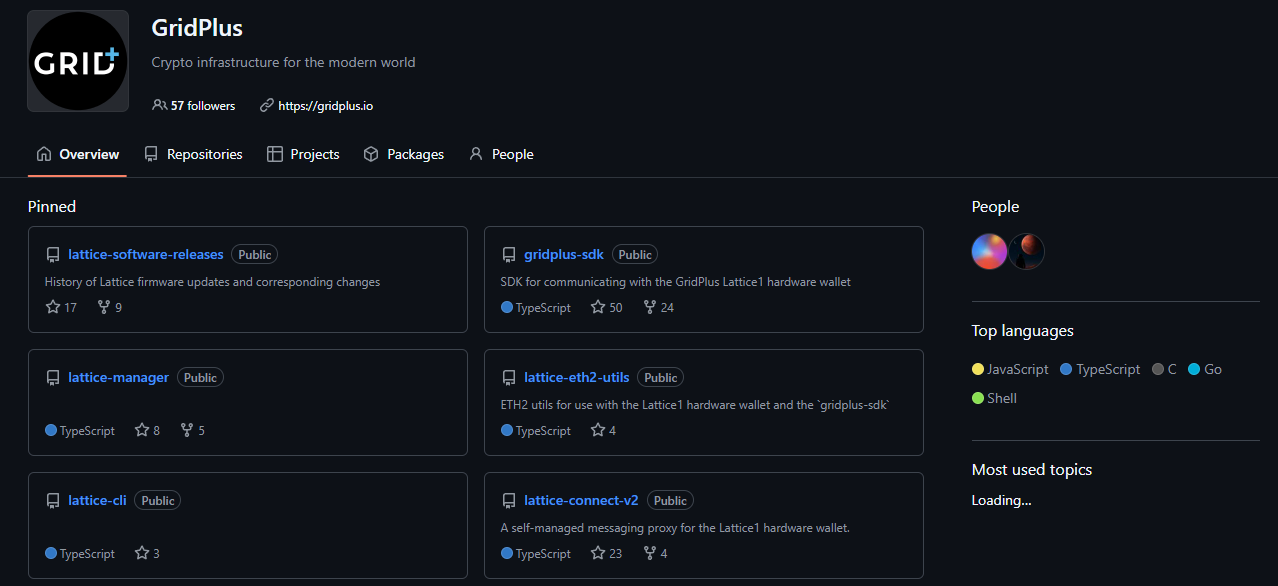
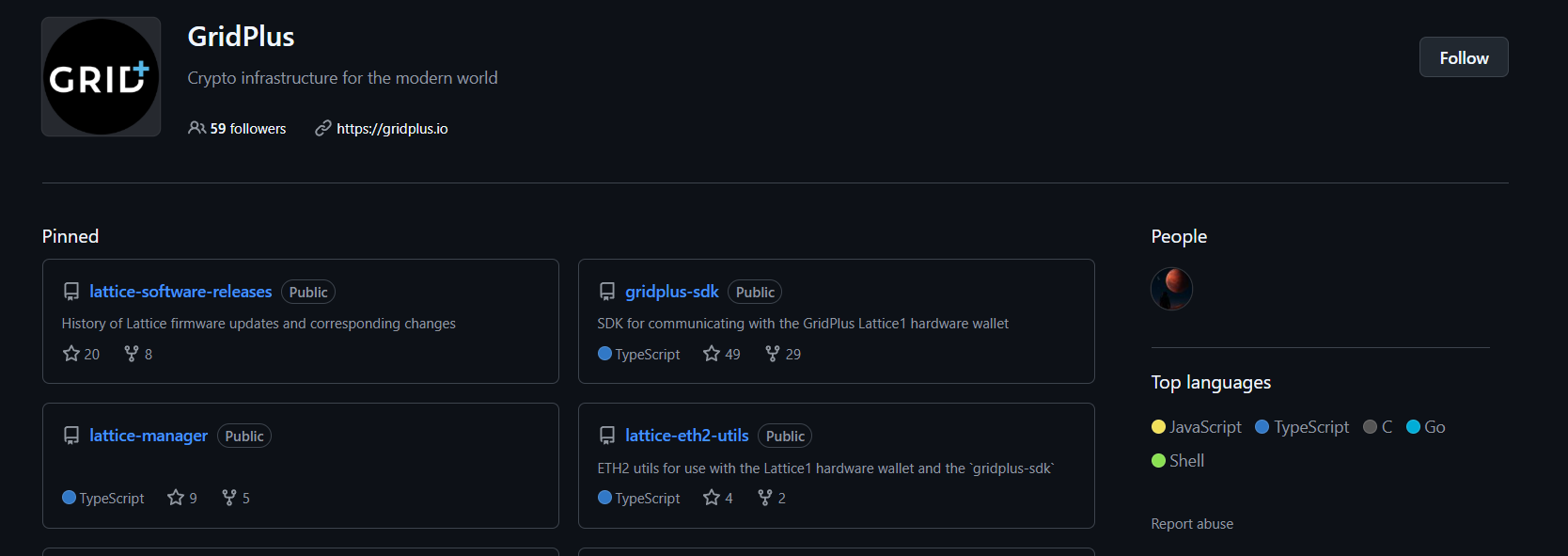
Captures of github.com/GridPlus supplied by this website's maintainer; the captures do not display their dates.
After raising millions through its original electricity venture, abandoning that business, and pivoting to hardware wallets, what meaningful commercial and product-development progress has GridPlus delivered in recent years? Now not receiving updates in over a year, is the Lattice’s destiny to become a paperweight? We’ll let you decide.
Where the history leads.
The history above provides context for the present dispute: PLH (a GridPlus Inc shareholder) alleges that GridPlus’s CEO fraudulently induced it to enter a share-purchase agreement to discourage investor outreach and prevent disruption to GridPlus’s ongoing financing process.
Read the correspondence timeline